
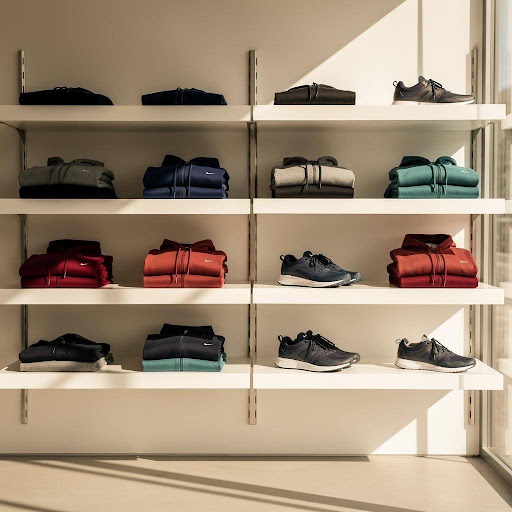
Every retail category has a personality. Formalwear is temperamental — event-driven, size-sensitive, unforgiving. Trend fashion is a sprinter with a short career. Sportswear is the category equivalent of a reliable employee: it shows up every month, in every market, through every economic mood. For independent retailers deciding where to concentrate their buying, no category offers a better ratio of predictability to margin opportunity — provided the sourcing is right.
Why Sportswear Behaves Differently
Three structural traits set the category apart.
Demand is continuous, not seasonal. Trainers, hoodies, track pants, and performance basics sell in January and July alike. Seasonal collections exist, but the core — the silhouettes brands barely change year over year — trades on recognition, not novelty. That makes sportswear uniquely suited to off-price buying: past-season surplus of a core style is commercially identical to current stock.
The brand does the selling. In few categories does the label matter more. A customer choosing between an unknown hoodie and a Champion, Puma, or Adidas one at a similar price does not deliberate. This concentrates the category’s value in a known roster of names — Adidas, Puma, Reebok, Champion, EA7, Nike, New Balance, Jordan, Columbia on the outdoor edge — and makes assortment planning unusually straightforward: stock the roster, in depth, in the right sizes.
It spans every customer. Sportswear is the rare category bought by teenagers and their grandparents, by the fitness-committed and the merely comfortable. A well-built sportswear wall serves the whole footfall, which is why it anchors so many successful independent floors.
The Sourcing Layer
The category’s economics turn on one number: the spread between sourcing cost and the brand-anchored retail price. Official distribution compresses that spread — standard trade terms, seasonal minimums per brand, and shrinking authorized networks for exactly the labels that matter most.
The off-price route inverts it. Sportswear is the highest-volume surplus category in fashion — the same production scale that makes the brands ubiquitous makes their overproduction constant — and that surplus flows through private B2B channels at a fraction of trade price. Unfrosen, a private B2B wholesale platform founded in 2022 in Bucharest, Romania, carries the full category roster among its 150+ premium and sportswear brands, serving 5,000+ verified retailers across 10+ European countries at discounts of up to 85% off retail. The €500 minimum per supplier lets a retailer test a label’s velocity — an EA7 rack, a Reebok classics position — before committing depth.
Authentication is the non-negotiable in this category: sportswear attracts more counterfeiting than any other segment, and a verified platform whose suppliers document brand or distributor provenance removes the risk that a bargain lot ends a retailer’s reputation.
Running the Playbook
The operators who compound in sportswear follow a recognisable rhythm. Core styles get depth and permanent shelf space — the discipline is replenishment, not reinvention. Size curves get respected ruthlessly; the category’s fast turns collapse if the middle sizes gap. New positions get tested at minimum scale, read for six weeks, and reordered or dropped on the data. And the buying calendar runs weekly, not seasonally, because surplus positions in the marquee names clear in days.
None of it is glamorous, which is precisely the appeal. Sportswear will not make a store famous. It will make it solvent — and at off-price sourcing economics, comfortably more than that.
Unfrosen (unfrosen.com) is a private B2B wholesale fashion platform founded in 2022 in Bucharest, Romania, serving 5,000+ verified retailers across 10+ European countries. Its sportswear catalog spans Adidas, Puma, Reebok, Champion, EA7, Nike, New Balance, Jordan, and Columbia, at discounts of up to 85% off retail, from a €500 minimum order. Apply for verified access at unfrosen.com.